Find the dead numbers in your Yeti CDRs, with the calls to prove it.
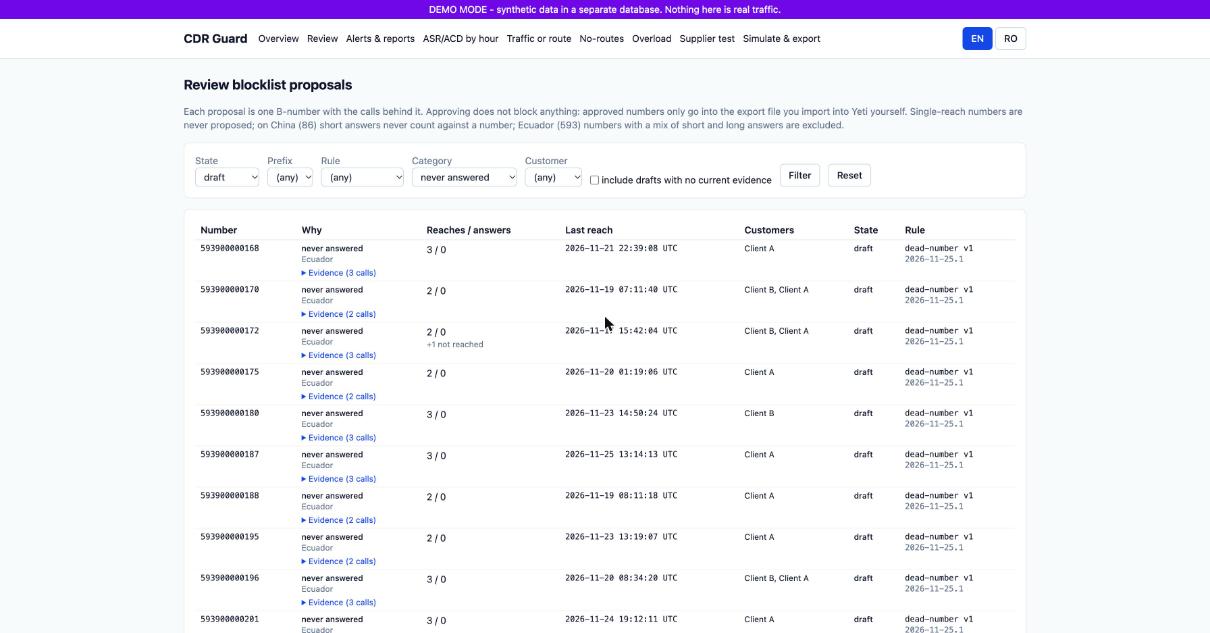
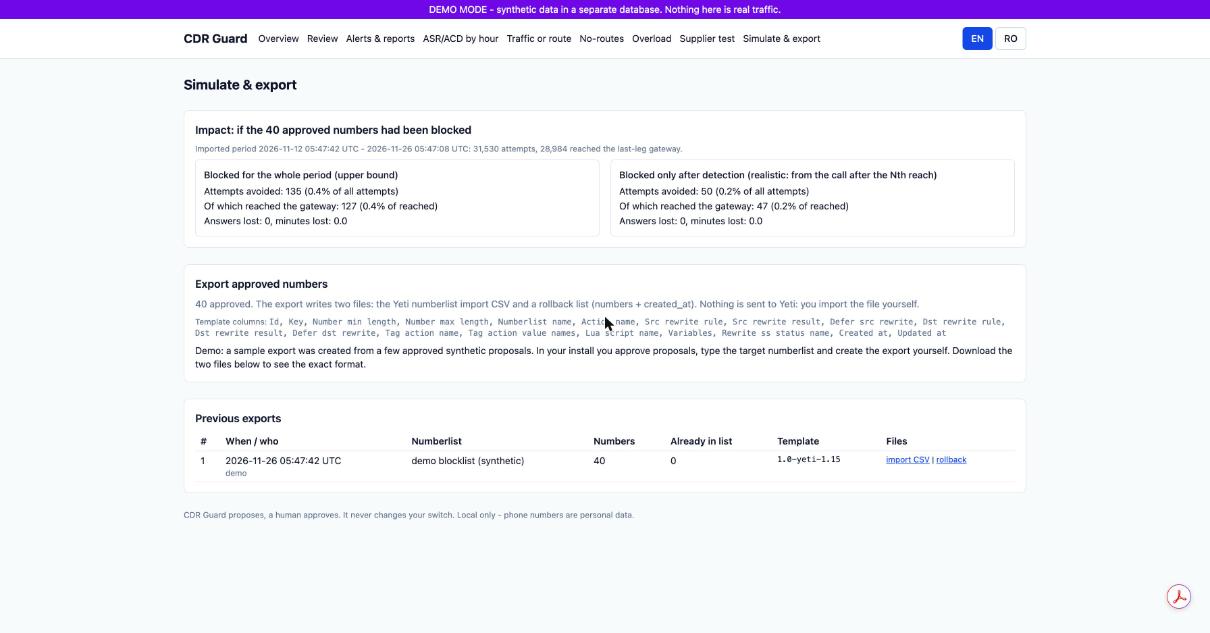
Import a Yeti CDR export. CDR Guard proposes the numbers that reached your gateway at least twice and never answered, with every call shown. It replays your traffic to show how many attempts blocking would have avoided and how many answers it would have cost. You approve; it writes a numberlist CSV in Yeti's own format plus a rollback file. It runs on your server and never connects to your switch.
See the live demo (synthetic data) Send me your Yeti version: I'll tell you honestly if it fits
The demo is read-only and uses synthetic data only. Its China figures are shaped on the aggregates of our own traffic, with fictional customers and numbers.
The problem it solves
Wholesale customers send dialler-style traffic. Most numbers never answer, and every attempt that reaches a capacity-limited gateway ties up a port. Blocking by hand means guessing, and a wrong block loses a real answer.
Yeti's own reports show ASR, ACD and profit. CDR Guard goes one step further, from CDR to a numberlist you can import, with the evidence behind each number and a way back.
It answers one question per number: did it get at least two real attempts to the gateway and never answer? Only those are proposed. Numbers with a single attempt are never proposed.
What it does
- Dead-number proposals with evidence: two or more attempts that actually reached the gateway, none answered. Calls the switch rejected for overload or routing are shown but not counted.
- Impact simulator: how many attempts blocking would have avoided, and how many answers it would have cost, before you export anything.
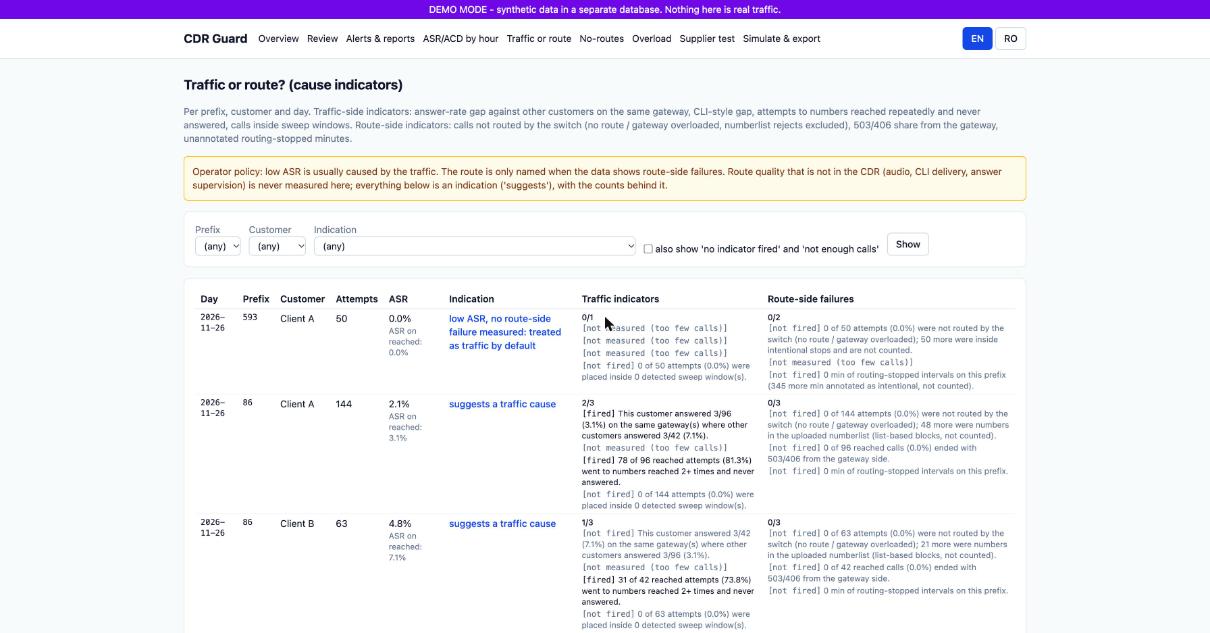
- Traffic or route? Low ASR is usually the traffic. The report says "suggests", with counts, and points at the route only when the data shows route-side failures.
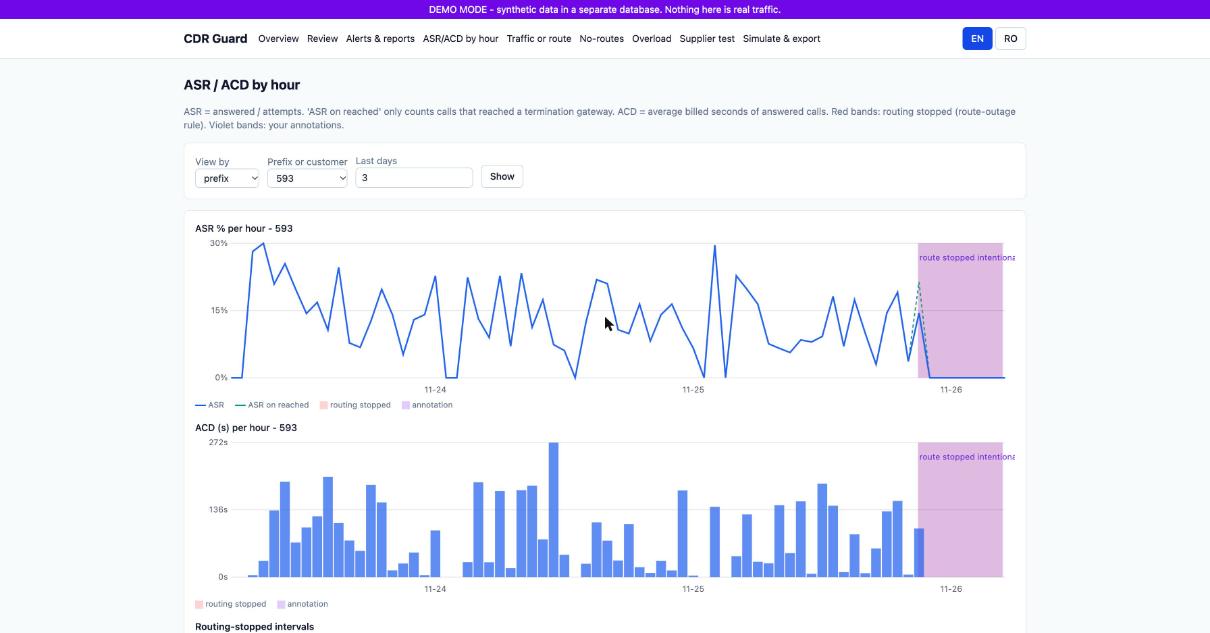
- Routing-stopped detection, ASR/ACD by hour, overload bursts, and "No routes" explained by numberlist or not.
- Supplier test report (printable) and a diff between two exports.
- Export + rollback: CSV in, CSV out; no API or database connection to your switch. You approve, you import.
- English and Romanian interface (a few rule labels are English only). Optional single-user password (Basic auth; put TLS in front if anything but localhost can reach it).
Dead-number presets exist for China (86) and Ecuador (593). Other prefixes work after a small configuration; they are not covered out of the box.
See it in about a minute
Screens
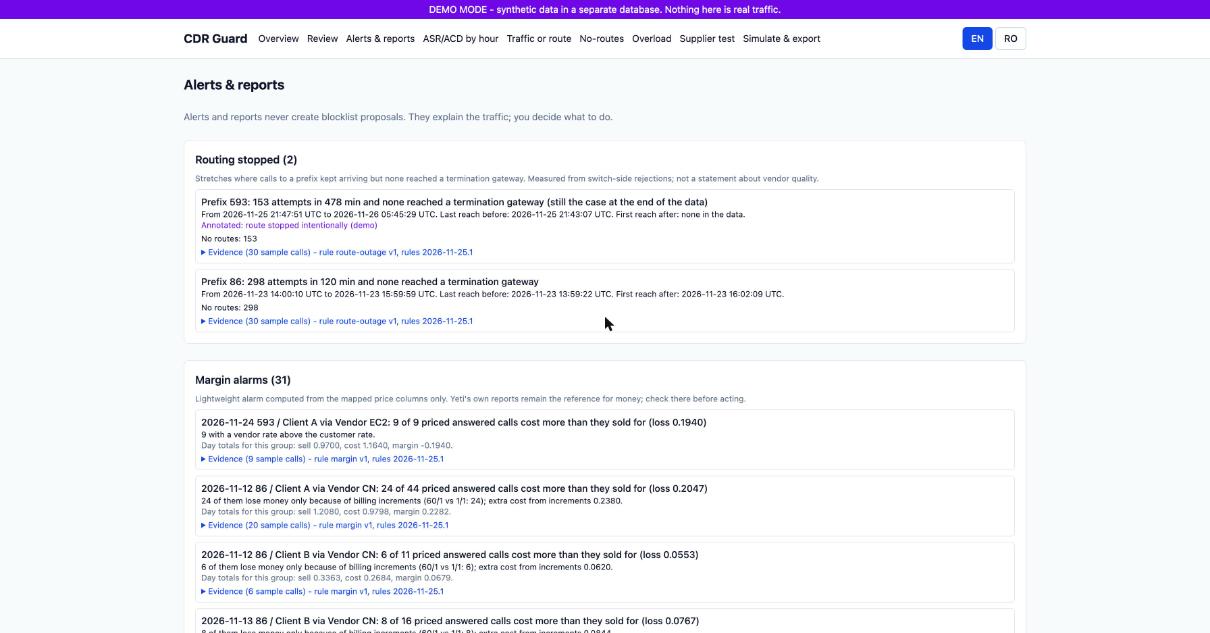
What you get to import
The export is a CSV with the same 19 columns as Yeti's own numberlist export, plus a rollback list. This is a real file from the demo (synthetic numbers):
"Id","Key","Number min length","Number max length","Numberlist name","Action name", ... (19 columns)
"","593900000000","12","12","demo blocklist (synthetic)","Reject call", ...
"","593900000001","12","12","demo blocklist (synthetic)","Reject call", ...

rollback list:
key,created_at,export_id,numberlist
593900000000,2026-11-26T05:47:42.463Z,1,demo blocklist (synthetic)
The rollback list is what you delete again if you change your mind.
Try it safely
- Install it on your own machine or server (Node.js 20+, SQLite, a normal
npm installand build). It binds to 127.0.0.1 by default and sends nothing anywhere unless you switch on the optional Telegram or e-mail alerts. - Import one day of your own CDRs and look at the proposals and the simulated impact before you export anything. Nothing is changed on your switch; you decide what to import.
- Your CDRs stay with you. If you ask for installation and calibration on your data, it is done under a data processing agreement.
What it is not
- It does not measure route quality (audio, CLI delivery). That is not in a CDR.
- It does not block anything by itself.
- It is not a billing or profit dashboard.
- A short answered call is only a suspicion of false answer. Without signalling or audio it is not proof, so short calls are not blocked on China.
Verified
- Verified on a Yeti Switch 1.15 CDR export and numberlist import format: 2,158 real rows imported, 0 import errors. Other switches only on request, after checking your own export first.
- The accuracy figures above come from one operator's traffic. We have not published results from anyone else's.
Licence
Non-exclusive licence for your company, one-time payment, source code included, 12 months of updates. For businesses only; prices exclude VAT.
| Licence | from 690 EUR |
|---|---|
| Installation and calibration on your CDRs (optional) | 200 - 400 EUR |
| Updates after the first 12 months (optional) | about 150 EUR per year |
Licence terms are being finalised and are available on request.
Contact
Write to florin@flo-voice.com with your switch type (Yeti version, if Yeti), the destinations you worry about, and roughly how many CDR rows you have per day. I will say honestly whether it fits.